Choose a towel and check your mop
Worn cotton towels are useful for mop pads because their loops can pick up water and loose dirt. Choose a towel that is clean and still sturdy, even if its edges are frayed or its color has faded. Avoid fabric that sheds heavily, has weak patches that tear when pulled, or was used to wipe up chemicals you cannot confidently wash out. Wash and dry the towel before cutting so you can judge its condition and work with its usual size.
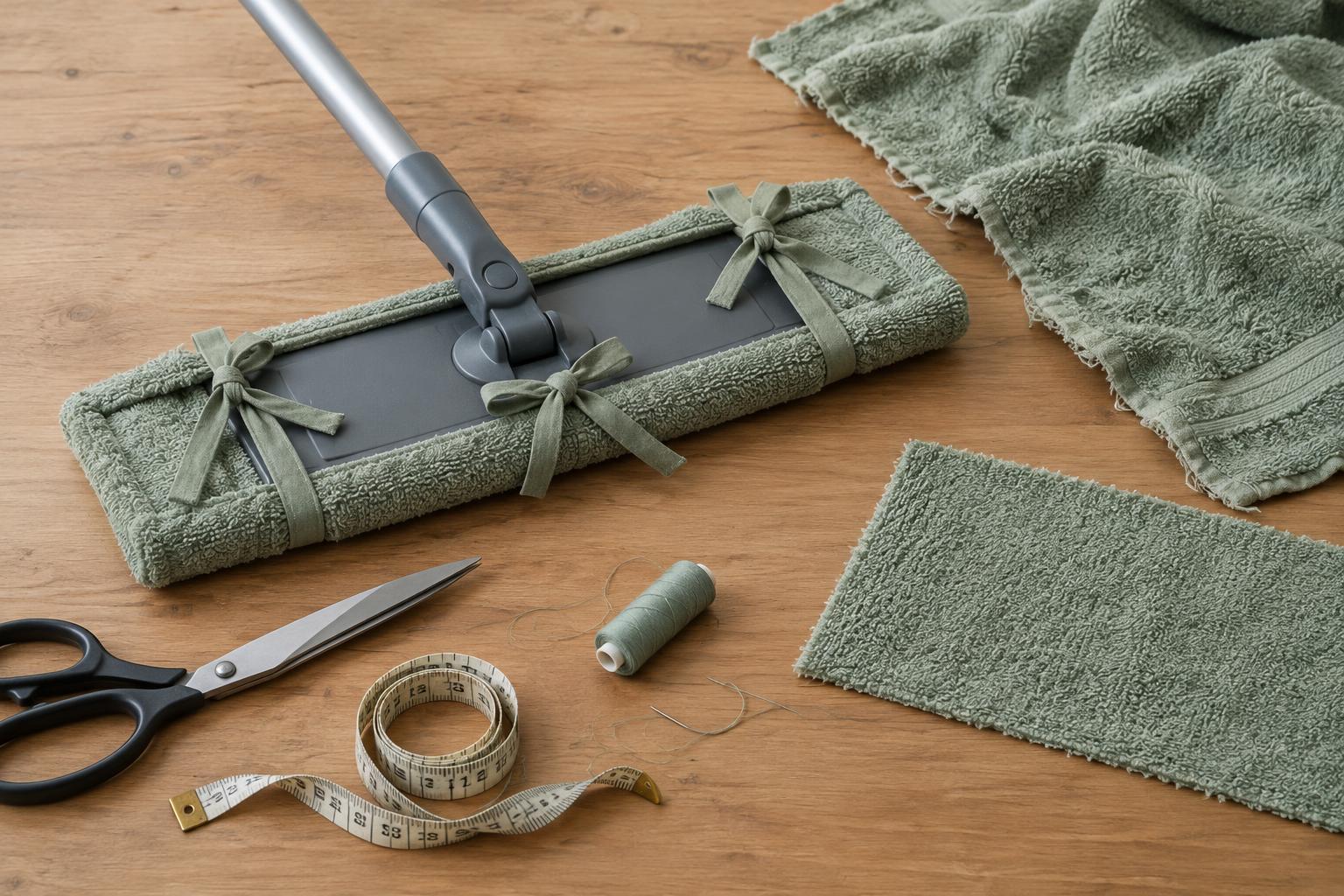
This project makes a tie-on pad for a flat mop head. Before cutting, check that there is room above the mop plate to fasten ties without blocking a hinge, spray nozzle or moving part. If your mop relies on clips, slots or a particular sleeve shape, use an existing pad as a guide instead; ties may not hold securely on every design. Keep the towel’s soft side against the floor and all knots on top of the mop head.
Measure and cut the pieces
Gather a ruler or tape measure, fabric scissors, pins or clips, thread and a sewing machine or hand-sewing needle. You will also need narrow strips of sturdy washable fabric for four ties. Old cotton sheeting works well. If you use towel fabric for the ties, test a strip first: thick terry can make bulky knots.
Measure the length and width of the mop plate, not the handle or the full width of its attachments. Cut two towel rectangles, each about 5 cm longer and 5 cm wider than the plate. With a 1 cm seam allowance on every edge, the finished pad will extend about 1.5 cm beyond each side of the plate. That small overhang helps cover its edges without leaving so much loose fabric that the pad bunches up. If your towel is very thick, cut one rectangle instead and use the single-layer option described below.
Cut four ties long enough to reach from a corner of the pad toward a matching tie across the top of the mop plate, with enough extra length to make a secure knot. Hold a trial strip in place on your mop to find a practical length. Fold the long raw edges of each strip inward, fold again, and stitch along the length. Finished fabric ties are less likely to fray than raw strips.
Sew the pad and attach the ties
For a two-layer pad, place the towel rectangles together with the sides you want visible facing inward. Pin around the edges. Sew with a 1 cm seam allowance, leaving a gap large enough to turn the pad right side out. Trim excess fabric from the corners without cutting through the stitching. Turn the pad, ease the corners into shape, fold the gap’s raw edges inward and topstitch around the entire edge to close it. A second line of stitching near the edge can help thick fabric lie flatter.
Lay the finished pad cleaning-side down. Position one tie near each corner on the upper side, with its free end pointing toward the center of the pad. Stitch each tie in place firmly; a small rectangle of stitching with a diagonal across it is a useful way to reinforce the attachment. Place the pad under the mop head and knot the two ties at each short end across the top of the plate. Check that the pad sits flat, the knots stay clear of the floor, and the mop can move freely before cleaning.
For a thick towel, a single layer may slide more easily under furniture. Cut it to allow for a narrow hem and a little overhang beyond the mop plate. Fold and sew the raw edges, then attach the ties as above. If the towel is too bulky to fold twice, use a zigzag stitch around the cut edges before turning up one narrow hem.
Use, wash and troubleshoot your pads
Use the pad dry for loose dust or lightly dampened for suitable hard floors. Follow your floor manufacturer’s care guidance, especially for wood or other surfaces that should not be left wet. Remove grit before damp mopping so it does not drag across the finish. Change the pad when it becomes dirty rather than pushing debris around, and do not use one pad for both bathroom and kitchen floors without washing it between uses.
After use, shake loose debris into a bin and launder the pad according to what the towel fabric can tolerate. Let it dry thoroughly before storage. Fabric softener can reduce a towel’s absorbency, so leaving it out may help the pad keep working well. If the pad slips, shorten or reposition the ties and check that they are knotted on top. If it bunches at the edges, trim the next version closer to the mop head. Your first pad can serve as a template once you have found a fit that moves smoothly.