Choose the right knife and prepare your workspace
A craft knife is useful when scissors cannot easily reach an interior shape or make a clean cut along a ruler. For most paper and card projects, start with a comfortable handle that holds its blade securely. Use a sharp blade suited to the material: a dull one can snag fibers and tempt you to press harder. Check that the blade is firmly fitted before you begin, following the knife maker’s instructions.
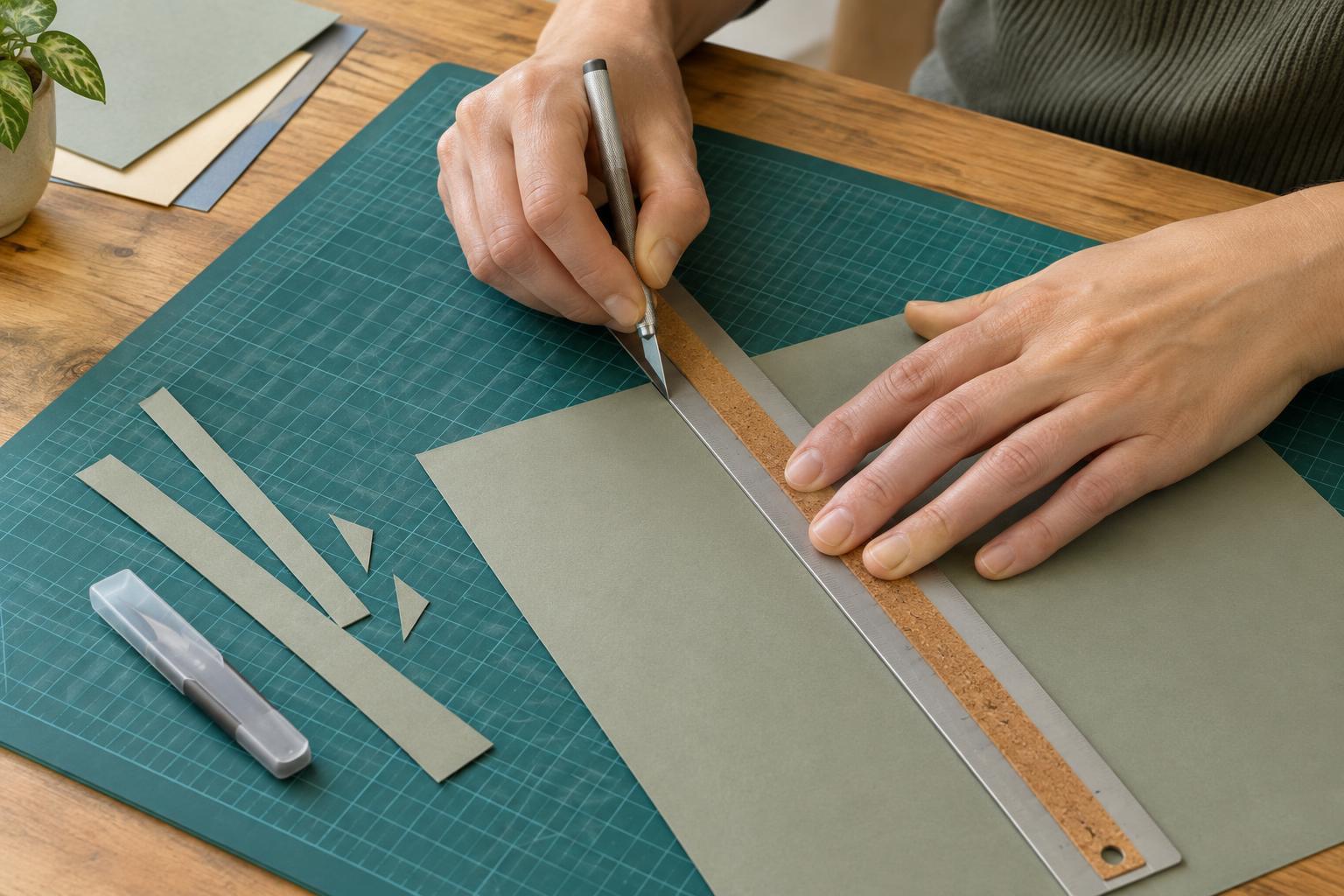
Place a self-healing cutting mat on a stable, flat table. A mat protects the surface underneath and gives the blade a consistent surface to meet. Clear away scraps, drinks and loose tools so nothing catches your arm. Good lighting helps you see both the marked line and the blade tip. Keep children and pets away from the cutting area, and provide close adult supervision if a child is taking part in a project that involves blades.
Set your hands for control
Sit or stand so you can see the full line you intend to cut without stretching across the table. Hold the knife like a pencil, with a relaxed but secure grip. Keep your other hand well clear of the blade’s path, including the space beyond the end of the line. Cut in a direction that moves the blade away from your body and your supporting hand. If the angle feels awkward, turn the mat and material instead of twisting your wrist into an unstable position.
For a straight line, use a metal ruler or another straightedge designed to resist blade damage. A ruler with a nonslip backing is easier to hold steady. Press it firmly with fingertips set back from the cutting edge; never curl a finger over the side the blade will follow. Before cutting, make a practice motion with the knife raised slightly to check that the ruler, your hand and your elbow all have room to stay in place.
Make straight cuts in light passes
Mark the cut line clearly and position the material flat on the mat. Hold the ruler on the side of the line you want to keep, so a small slip is less likely to mark the finished piece. Set the blade tip at the start of the line, then draw it smoothly along the ruler using light, even pressure. Let the sharp edge do the work rather than trying to cut through thick card in one stroke.
If the first pass does not go through, keep the ruler in place and follow the same groove with another light pass. Lifting and resetting the ruler can shift the guide and leave a ragged edge. For an interior opening, begin at a corner and stop at the next corner rather than cutting past it. Turn the material to approach the remaining sides. Check that the cut is complete before lifting the piece; pulling at an attached corner can tear it.
Cut curves and small details without forcing the blade
Curves are easier to control when you turn the material gradually while guiding the knife forward in short movements. Keep the supporting hand away from the blade and move it only when the knife is stopped. For a tight curve, work in several short passes instead of trying to swing the knife around the shape in one motion. Practicing on an offcut of the same material can help you find a comfortable pace.
Small points and narrow cutouts need a sharp blade and patience. If the material buckles, tape its outer edges to the mat with low-tack tape, testing first on a scrap if the surface is delicate. If the blade drags, tears fibers or wanders off the line, stop. Check whether the material is shifting, the blade has become dull or you are pressing too hard. Repeated heavy cuts can damage the mat and make a slip more likely.
Finish, store and replace blades safely
When the cut is done, put the knife down with its edge protected: fit the cap or retract the blade before moving scraps or reaching for another tool. Never leave an uncovered knife buried among paper or fabric. Store it where its blade cannot be touched accidentally, and avoid carrying an exposed knife across the room.
Change a dull or damaged blade according to the knife maker’s instructions, working over the mat with your fingers away from the edge. Do not use the blade as a pry tool or try to straighten a bent tip. Put used blades in a rigid, closable container rather than loose in a waste bag, and check local disposal guidance before discarding the container. A tidy workspace, a protected blade and a few careful passes make the next project easier to start safely.