Choose paper that will hold its shape
A flat paper weave is made from two sets of paper: a slotted base and separate strips threaded across it. Choose medium-weight colored paper or lightweight cardstock for the base. It should bend enough to lift while weaving but stay firm when laid down. Use similar-weight paper for the strips so neither part overwhelms the other. Two contrasting colors make the over-under pattern easier to see.
You will need a ruler, pencil, scissors or a craft knife, a cutting mat if using a knife, and a glue stick. A bone folder is optional; the edge of a ruler can also help flatten the finished weave. Before cutting your final piece, try one strip through a scrap of the chosen base paper. If the base creases or tears easily, use slightly sturdier paper.
Cut a regular slotted base
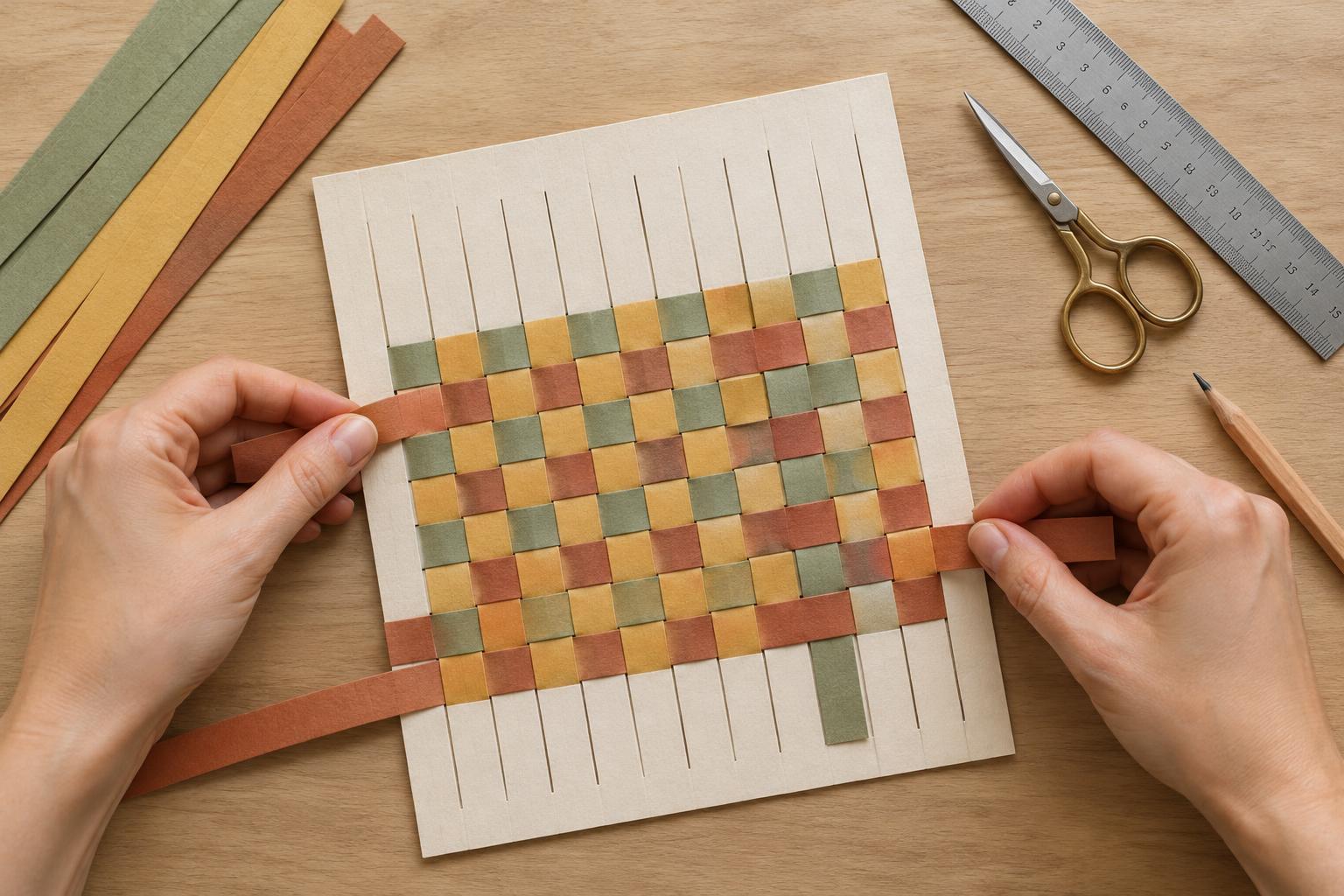
Start with a 20 cm square. On the back, draw light vertical guide lines from 1.5 cm below the top edge to 1.5 cm above the bottom edge. Space the lines 1 cm apart, beginning about 2 cm from the left edge and ending about 2 cm from the right edge. Cut along each line, leaving the top and bottom borders intact. These borders hold the vertical paper bars together.
For straight slots, place the base on a cutting mat and guide a craft knife along a ruler. If you prefer scissors, fold the square horizontally, cut from the folded edge toward the open edges, and stop 1.5 cm before reaching them. Unfold and gently smooth the crease. Work slowly either way: cuts that extend into the border weaken the base, while noticeably uneven spacing makes it harder to keep the woven rows straight.
Weave one row at a time
Cut strips about 1 cm wide and 20–21 cm long. A paper trimmer can make repeated widths easier, but measured pencil marks and scissors work well too. Prepare roughly 17 strips, then add or remove one as needed to fill the slotted area without crowding it. Keep the strips in a small stack so their edges do not get bent before weaving.
Start near the top of the slots. Feed the first strip across the base, passing it over one vertical bar, under the next, and so on. Lift each bar only as much as needed; pulling a strip through several slots at once can catch an edge and cause a tear. Center the strip so it extends a little past both sides. For the next row, reverse the pattern: wherever the first strip went over, the second goes under. Continue alternating the starting position for every row.
Keep the pattern flat and even
After each row, slide the new strip gently toward the one above it. Aim for rows that sit close together without overlapping or forcing the vertical bars to bow. Check both ends as you go, since a strip pulled too far to one side can make the whole piece look uneven. If a row tilts, ease it back into position before adding another; small adjustments are simpler while the strip is still loose.
Buckling usually means the strips are packed too tightly, the paper is too thick for the slots, or a strip has been tugged hard at one end. Remove the most recent row and rethread it with less tension. If a cut edge catches repeatedly, trim off any rough fibers rather than pulling harder. Slight gaps are preferable to a surface that will not lie flat.
Secure the edges and put the weave to use
When the slotted area is filled, check that the rows are straight and the base lies flat. Place a small amount of glue where the strip ends meet the side edges of the base, then press them down. Avoid spreading glue across the woven center, where moisture may cause ripples. Once dry, trim the ends to an even length, leaving enough paper beyond the outermost slots to keep them secure.
For a tidier back, glue the finished weave to a slightly larger sheet of paper or cardstock. Apply glue mainly around the edges and press the piece beneath a clean, lightweight book while it dries. The finished panel can become a greeting-card front, a bookmark cut from a larger weave, or a decorative insert for a handmade frame. Once the basic checkerboard feels comfortable, experiment with wider strips or a carefully planned color sequence while keeping the same gentle, even tension.